Electrical Outlet Not Working? Troubleshooting Steps Before Calling an Electrician
An electrical outlet that suddenly stops working does not always need replacing. The problem could be a switched-off power point, a faulty appliance, or a protective device that has disconnected the supply.
Before booking a repair, a few external checks can help you identify what is affected and whether there is a straightforward explanation.
This guide covers checks you can make without removing outlet covers, exposing wiring, or working inside an electrical panel.
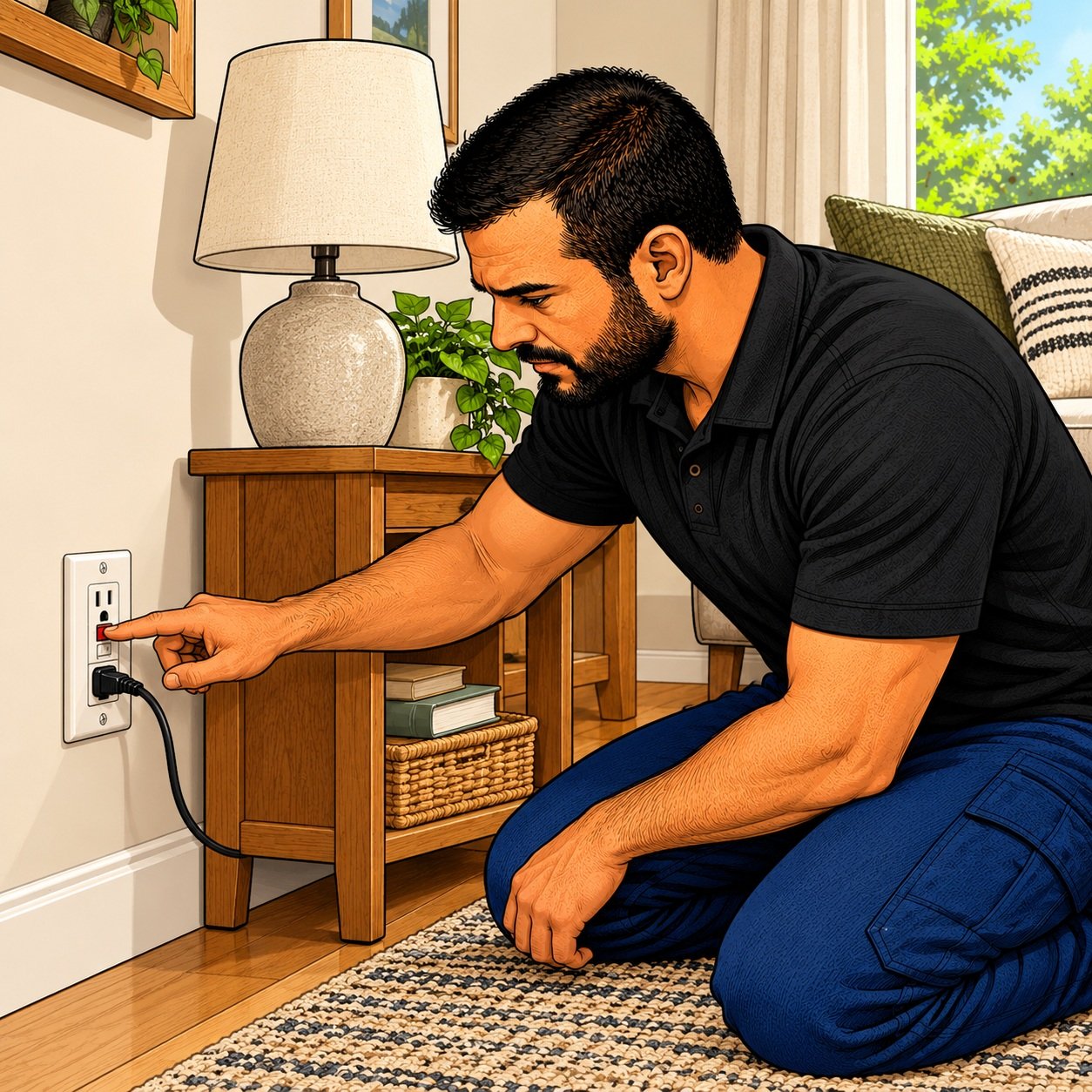
Start Here: Find Out Why Your Electrical Outlet Is Not Working
Look at the outlet and surrounding area before plugging anything into it.
- One appliance does not work: Check the appliance, its controls, and its power lead.
- One outlet is dead but nearby outlets work: Check for a wall switch, local power switch, or upstream protective device.
- Several outlets stop working together: Check for a circuit interruption, tripped breaker, GFCI, or safety switch.
- The problem starts after rain or a spill: Stop using the affected equipment and arrange an assessment.
- The outlet is discolored, cracked, buzzing, or smells burnt: Stop troubleshooting and call an electrician.
- Lights and outlets fail across a wider area: Check for a utility outage.
Safety warning: If you see smoke, active sparking, or fire, keep clear, evacuate as needed, and call emergency services. Do not touch an outlet or plug that appears damaged, wet, or overheated.
In Australia, an outlet is usually called a power point. GFCI protection is common terminology in the US and Canada; Australian homes commonly use RCD safety switches. Their arrangements differ, so follow the instructions for your equipment.

Tools and supplies
- Flashlight
- A small, known-working plug-in lamp suitable for your local supply
- Phone or notebook
- Appliance instructions
- GFCI, breaker, or safety-switch instructions, if available
- Access to the circuit directory or switchboard labels
You do not need a screwdriver, multimeter, or exposed-wire tester for these checks.
A lamp can help show whether an outlet supplies power. It cannot prove that the outlet is correctly wired, properly grounded, or safe for continued use.
For Australian readers: Fixed electrical work should be left to a licensed electrician. Queensland’s Electrical Safety Office explicitly warns against unlicensed DIY electrical work. Rules and permit requirements also vary across US and Canadian jurisdictions.
1. Check for Visible Damage Before Testing
Inspect the outlet from the outside.
Look for:
- Cracks or missing pieces
- Brown or black marks
- Melted plastic
- A plug that hangs loosely
- Moisture around the outlet
- Buzzing, crackling, or a burning smell
Do not touch the outlet to find out whether it is hot. Do not wiggle a plug to make an intermittent connection work.
If there are warning signs, stop using it. Where safe, switch off the identified circuit using its normal external control and arrange professional help.
A dead outlet should still be treated as potentially energized. Failure to operate an appliance does not establish that the wiring is safe to touch.
2. Check the Appliance and Its Power Lead
If the outlet appears intact and dry, check the item that stopped working.
Confirm that:
- Its power switch is on.
- Its controls are set correctly.
- The plug is fully inserted.
- Any detachable lead is properly connected.
- The appliance is not in a delayed-start or standby mode.
Visually inspect the unplugged lead and plug for damage.
Do not test a suspect appliance elsewhere if it has sparked, overheated, become wet, damaged its cord, or tripped a protective device. Leave it disconnected for assessment.
If the appliance appears sound and has no fault history, test the outlet with a small, known-working lamp. Confirm the lamp works at a known-good outlet first.
If the lamp operates normally, the original appliance may need further investigation.
3. Check Wall Switches and Local Power Controls
Some outlets are intentionally controlled by a wall switch.
This is particularly common for lamps in US and Canadian homes. One receptacle in a duplex outlet may be switched while the other remains continuously powered.
Check nearby switches without removing their covers.
For Australian power points, confirm that the individual outlet switch is on. Also check accessible controls on smart plugs or timers.
If the appliance connects through a power strip:
- Check the strip’s normal power switch.
- Check its instructions for any user-operated overload control.
- Inspect it for damage.
- Test the lamp directly at the wall outlet if safe.
Stop using a strip that smells burnt, has damaged sockets, or repeatedly trips. Do not connect power strips together to provide more outlets. Technical Safety BC advises against this practice.
4. Find Out Whether Other Outlets Are Affected
Check nearby outlets using the same small lamp, provided each outlet appears safe.
Make a short list of what works and what does not.
For example:
- Bathroom outlet: not working
- Hallway outlet: working
- Garage outlet: not working
- Bedroom lights: working
Outlets in different rooms may share a circuit or protective device. Nearby outlets may also belong to different circuits, so physical proximity does not confirm how they are connected.
Check utility outage information if several circuits or neighboring properties are affected.
If some lights become unusually bright while others dim, or several appliances behave abnormally, stop using affected equipment and contact the utility or an electrician urgently.
5. Check for a Tripped GFCI Outlet
In the US and Canada, a GFCI outlet can disconnect power to other outlets connected downstream.
The controlling device may be in a bathroom, garage, basement, kitchen, or another location. A dead outlet does not need its own TEST and RESET buttons to be GFCI-protected.
If the GFCI and surrounding area are dry and undamaged:
- Disconnect accessible plug-in loads on the affected circuit where safe.
- Read the device’s instructions.
- Press RESET as directed.
- Check whether power returns with the lamp.
Do not force the button or repeatedly reset a device that trips again.
A GFCI may refuse to reset because it has no incoming power, an ongoing fault, or an internal problem. Leviton identifies these as possible causes; failure to reset does not by itself prove the outlet needs replacing.
Indicator colors differ between products. Read the instructions for that model rather than assuming every green or red light means the same thing.
6. Check the Circuit Breaker or Safety Switch
Only approach the panel or switchboard if it is dry, intact, and accessible.
Do not open it if there is water, scorching, buzzing, a burning smell, or visible damage.
Use only normal external operating handles behind the user-accessible door. Never remove the panel cover or touch internal components.
For a clearly identified tripped device:
- Disconnect accessible plug-in loads where safe.
- Follow its operating instructions.
- If the instructions permit, reset it once.
- For many breakers, this means moving fully to OFF before returning to ON.
- If it trips again, leave it off and arrange an assessment.
Some devices combine several protective functions. A standard breaker, GFCI, AFCI, RCD, or combined device may respond to different faults.
In Australia, safety-switch guidance allows checks involving accessible plug-in appliances and user-operated reset controls. A switch that will not reset or keeps tripping needs further investigation.
Do not hold a switch on, bypass protection, fit a larger breaker, or replace a fuse as part of this guide. For unfamiliar or older equipment, call an electrician.
7. Check Whether an Appliance Is Linked to the Trip
If power remains restored with appliances disconnected, note what was operating when the problem began.
Possible clues include:
- Several high-power appliances running together
- A particular appliance starting immediately before the trip
- An outdoor appliance exposed to rain
- A damaged extension lead
- A problem that began after moving equipment
An overload and an appliance fault are different problems. The timing alone does not establish which occurred.
Leave any suspected faulty item disconnected. Do not move it to another circuit to see whether it trips that one too.
For other appliances with no warning signs, reconnect only as permitted by the equipment and local safety guidance. If protection trips again, stop resetting and arrange professional diagnosis.
8. Consider Moisture and Recent Changes
Check for:
- Rain entering an outdoor area
- A plumbing leak or spill
- Recent cleaning around the outlet
- Building or electrical work
- A newly connected appliance
- Drilling or fastening near concealed wiring
If moisture may have entered an outlet, leave it unused and arrange an assessment. A dry-looking faceplate does not prove the inside is dry.
Do not use a hair dryer, spray cleaner into the outlet, or remove its cover to inspect it.
If the problem began after electrical work, contact the installer. Do not attempt to correct connections yourself.
9. Check Whether Power Has Returned Normally
Confirm that:
- The lamp operates steadily.
- The outlet does not buzz or crackle.
- There is no burning smell.
- Protective devices remain set.
- Other affected outlets have also recovered.
Stop if power cuts in and out or the plug fits loosely.
If a trip has no clear explanation, arrange an assessment even if power returns. Restoration does not establish that the underlying cause has disappeared.
For GFCIs, follow the manufacturer’s TEST and RESET procedure and testing schedule. If the required test fails, stop using the protected outlets and arrange professional attention.
Common Mistakes to Avoid
- Assuming a dead outlet is safe to open: Treat it as potentially energized.
- Repeatedly resetting protection: A recurring trip needs diagnosis.
- Testing damaged appliances elsewhere: Keep suspect equipment disconnected.
- Wiggling a loose plug: An intermittent connection is a repair issue.
- Removing covers to inspect wiring: Keep homeowner checks external.
- Using extension leads as a permanent workaround: Repair the fault instead.
- Assuming one successful lamp test proves safety: It only confirms operation under that small load.
Keep Your Outlets Working Safely: Prevention Tips
- Inspect accessible plugs and leads for damage.
- Keep water away from outlets and electrical equipment.
- Follow appliance connection requirements.
- Avoid concentrating high-power loads on one power strip.
- Replace damaged accessories through the appropriate service route.
- Follow protective-device testing instructions.
- Report loose, discolored, or intermittent outlets promptly.
- Keep the circuit directory accurate when an electrician completes work.
Frequently asked questions
Why did one outlet stop working while the others still work?
It may be switched, supplied through a tripped protective device, or affected by a local or upstream fault. Check accessible controls first, then arrange an electrician if it remains dead.
Why is the outlet not working when the breaker looks on?
A separate GFCI may have tripped, a switch may be off, or an electrical fault may be interrupting the circuit. Breaker position alone does not confirm power at the outlet.
Can a GFCI in another room affect this outlet?
Yes. A GFCI can protect downstream outlets elsewhere on its circuit. Locate and identify the controlling device rather than assuming protection is in the same room.
Why does only half of a double outlet work?
One half may be wall-switched. If switching does not explain it, or there are signs of damage or intermittent operation, stop using the affected outlet and have it checked.
Can I replace the outlet myself?
Requirements depend on location, permissions, and competence. For this guide, leave outlet replacement and fixed-wiring work to a licensed electrician, particularly for Australian installations.
Should I use a non-contact voltage tester?
It is not needed for these checks. A non-contact tester cannot establish that an outlet is safely isolated, and a negative indication is not permission to touch wiring.
Related Posts